Hiking tips
What thousands of kilometres of Czech trails teach you — getting there, waymarks, water, pubs, sleeping out.
Everything below comes from walking, not from a guidebook. Czech trails are easy country to move through, but a few habits take a while to learn. Here they are, so you can skip the learning-the-hard-way part.
1 · Get the maps and the tracks
The Czech standard is Mapy.com — its Outdoor layer shows every waymarked route, and the app works offline: download the maps before you go and the phone navigates all day in airplane mode. Every trail on this site links its route there and offers a GPX download, so you can carry the exact line I walked. There is enough to say about this one app that it has its own guide.
2 · Let the train carry you
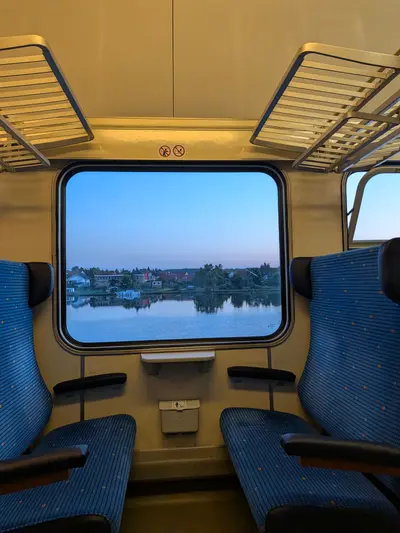
You rarely need a car here. Start at one station and finish at another — most trails on this site are point-to-point for exactly this reason. Check the last connection home before you set out, and treat the stations and bus stops along the way as exits if the day turns long. A Friday departure straight from work is a trick worth stealing: a short evening leg to a viewpoint, a night in a town, and the whole of Saturday for the long stretch.
Two apps cover the logistics: Můj vlak (Czech Railways) finds connections nationwide and sells the tickets, and around Prague the PID Lítačka app covers the integrated trains and buses, often cheaper.
3 · Trust the waymarks
The painted stripes on trees, posts and corners of buildings are dense and reliable enough to navigate whole days by — red for the long backbone routes, yellow often a short connection. The one thing they will not tell you is which route is worth walking. That is what the trail pages here are for.
4 · Plan in kilometres, not hours
Every trail here states its exact distance and ascent, never an estimated time — your pace is yours. Learn what a day feels like for you: how many kilometres, with how much climbing, and how much that drops on rock or in heat. The difficulty scale on this site is built the same way — from distance, ascent and terrain, not time.
5 · Carry water, hope for food
A village pub is a promise of beer, not of food. Many serve nothing to eat, kitchens pause between lunch and dinner, Monday is a common closing day, and the kiosks by castles and lookout towers vanish outside the season. Carry enough food to be independent of luck; the trail pages list the stops that existed when I walked, with the kilometre mark.
Water needs more respect. Springs are scarce on the dry volcanic hills, so fill up in every town, and in summer carry more than feels reasonable — two litres is a start, not a maximum.
6 · A night out, or a bed in a town
Multi-day walks come in two flavours. The civilised one: end the day in a small town, take a room, eat a hot dinner, start early. The other is čundr — the Czech tramping tradition of sleeping out under the open sky. If you sleep out, know the lines: in the national parks, camp only at designated sites. Elsewhere the tolerated form is a quiet bivouac — no tent, no fire, away from villages, reserves and fields, arriving late and gone early, leaving nothing.
7 · Read the seasons
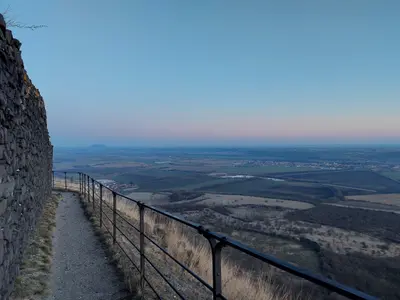
The same trail is several different trails a year. High summer turns the bare hills into ovens — shift to forests and river valleys, or start at dawn. Spring and autumn are the best time for the open, treeless country. Winter asks for more planning — short days, mud — but repays it with trails you have to yourself.
8 · Know where you are walking
Much of the best hiking lies inside protected areas. In a CHKO the rules are light; in the four national parks they are stricter, and their core zones mean staying on marked trails. The camping and fire rules from tip 6 tighten as the protection level rises. The regions map shows the real boundaries — worth a glance while planning.