Why hiking in Czechia
Hiking abroad comes in two extremes — crowded and paid-for, or empty and unsupported. The Czech countryside is the sweet spot between them, and the tourists haven't noticed.
In one kind of country, everything is arranged and everyone came: cable cars, entrance fees, huts booked out months ahead, a queue at the summit photo spot. In the other there is nothing at all — grand emptiness, but every litre of water carried and help far away when something goes wrong. Czechia sits between: civilised enough that a hike never becomes an expedition, empty enough that the trail is yours. This page is the case for it.
The sweet spot
The comfort half of the bargain: a waymarked route to everywhere, a village pub or a railway stop every couple of hours, phone signal on most summits, drinking water never far. Nobody charges you to enter a landscape, and there is no terrain you cannot simply walk out of.
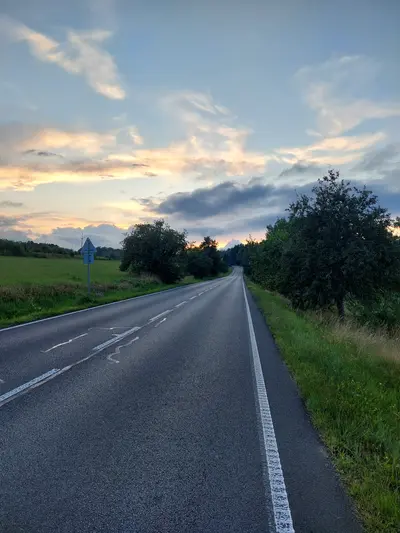
The emptiness half: international tourism never found the Czech countryside. Visitors crowd into Prague, take the day trip to Český Krumlov, and that is where it ends — castle ruins, sandstone towns and whole volcanic ranges an hour away see mostly locals, and on a weekday often nobody at all.
And the modesty is part of it. No four-thousanders, no coast, no glaciers — the highest point of the country is Sněžka at 1,603 m. What Czechia has instead is harder to photograph and better to live with: a country built for walking, more thoroughly than almost anywhere in Europe.
The waymarks
Czech trails have been marked by the hiking club KČT since 1889, and the result is often called the densest marked-trail network in the world — over 40,000 km of routes, all marked the same way: three painted stripes on a tree or a lamppost, white – colour – white, in red, blue, green or yellow. Junctions carry signposts with names and kilometre distances. After one afternoon you stop thinking about navigation at all — you follow the stripes, and the stripes are never wrong for long.
The trains
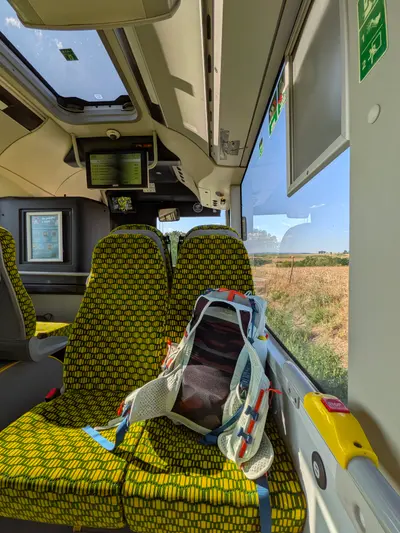
The rail network is one of the densest in Europe too, and it changes what a hike can be. You are not walking loops from a car park: a morning train to one village, a day’s walk across country, an evening train home from another. Nearly every trail on this site starts and ends at a station or a bus stop — and there is a beer at the end instead of a drive.
A landscape that keeps changing
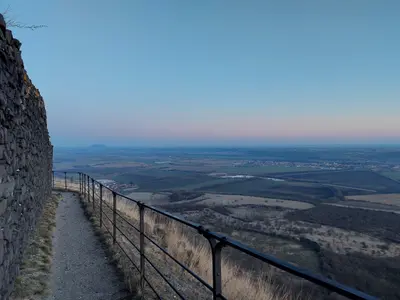
Nothing in Czechia is monumental, and nothing repeats. Within a couple of weekend train rides you can walk sandstone rock cities, the bare volcanic cones of České středohoří, deep spruce border ridges, hop gardens and orchard country, fishpond plains, and river canyons cut a hundred metres into the plateau. The country is small enough that the scenery changes completely within an hour of travel — and the walking culture is old enough that a marked route runs through all of it.
Protected, but lived-in
Four national parks and twenty-seven protected landscape areas cover roughly a sixth of the country, and the law lets you walk freely through nearly any forest. But this is not wilderness: the trails pass through working countryside — villages, chapels, castle ruins, lookout towers on the summits. Half the pleasure of a Czech hike is that civilisation is never more than an hour away.
Nothing to survive
Czechia is one of the safest countries in the world, and that reaches into the countryside: crime against hikers is essentially unheard of, and solo walking — solo women included — is completely ordinary. The wildlife is harmless: no bears outside one remote corner of the far east, and the only venomous snake is a shy adder you will be lucky to ever see. The terrain doesn’t bite either — no glaciers, no real exposure unless you go looking for it, weather that makes bad days rather than dangerous ones. And if something does go wrong, a village is rarely more than a few kilometres away and 112 works everywhere. The honest list of local hazards: ticks in the warm months — check yourself, consider the encephalitis vaccine — and sunburn on the bare ridges.
The pub at the end
The village pub is part of the trail infrastructure, and a cold Czech beer after 25 km is one of the best arguments this country makes for itself. Just don’t count on the kitchen — what to actually expect is on the tips page.
When to come
The core season runs April to October — May for orchard blossom and green barley, October for beech colours. But the lowland hills walk well in every month, and some of the hikes on this site were at their best on a freezing clear day in February. There is no off-season, only different countries wearing the same borders.
Convinced? Pick a region on the atlas, or start with any trail — every one has been walked in person.